
Public Web
The public surface of ecoma.io follows one strict URL model:
/<locale>/<mount>/<path>
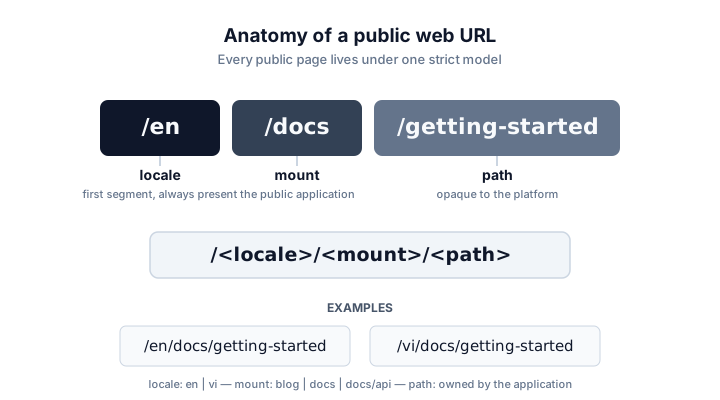
The three segments
- locale — the first segment, always present. Supported locales live in the
locale registry (
PUBLIC_LOCALESinapp/i18n). English is/en/..., Vietnamese is/vi/...; there is no unprefixed variant. - mount — the public application. Currently registered mounts in
app/layoutareblog,docsanddocs/api. A mount matches on a full segment boundary:/en/docsisdocs, while/en/bloggingis notblog. - path — everything after the mount. It is opaque to the platform; the application that owns the mount decides whether the resource exists.
Examples
| URL | Meaning |
|---|---|
/en | English locale root |
/en/docs | English docs, docs root |
/en/docs/getting-started | English docs, Getting Started |
/vi/docs/getting-started/installation | Vietnamese docs, Installation page |
Parsing is strict
Paths are not normalized or repaired. A trailing slash, an empty segment, or an unsupported locale are rejected with a typed reason rather than being silently fixed:
/en        → localized (en)
/EN/docs   → invalid (unsupported_locale)
/en/docs/  → invalid (trailing_slash)
/en//docs  → invalid (empty_segment)
Boundaries
/is a locale-resolution entry point. It never serves content and never redirects to an unprefixed path on its own; the caller decides the policy.docs/apiis a nested mount reserved for theapi-referencesurface. The home application does not serve it — a request for/en/docs/apiis rejected before content lookup.
Where the model lives
The URL model is not a convention that each page re-follows — it is enforced in
two small modules of apps/home that every public surface goes through:
app/i18nowns the locale dimension: thePUBLIC_LOCALESregistry, parsing the first segment and locale switching. It knows nothing about mounts or applications.app/layoutowns the mount topology: thePUBLIC_MOUNTSregistry (blog,docs,docs/api), matching a pathname to a mount and building links back.
Adding a locale or a mount means adding one entry to the corresponding registry; the rest of the platform derives from that data.
Next: Content and Locales